EN


42V 2A vs 42V 5A Scooter Chargers: What Buyers Should Check
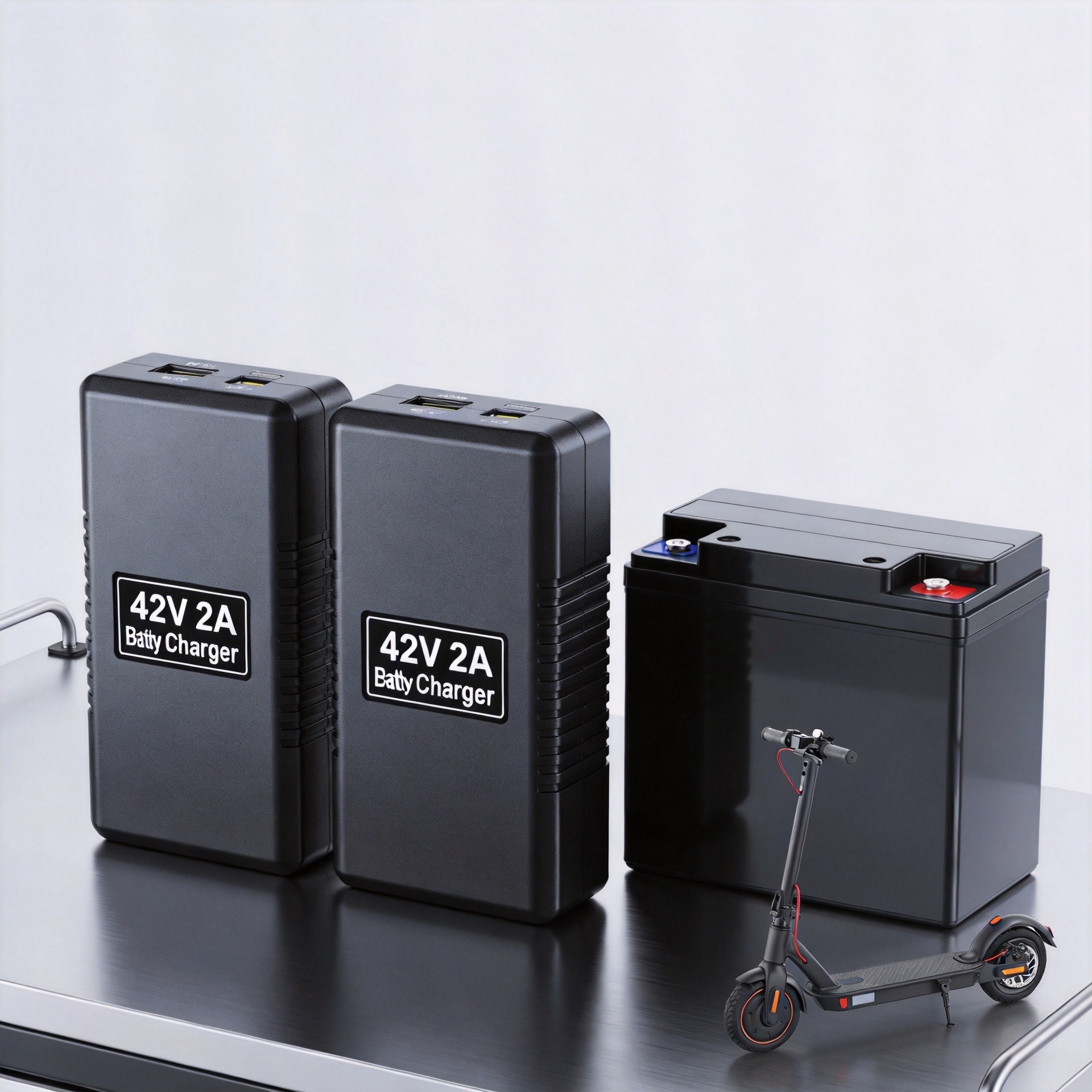
For a purchasing team, a 42V charger is not automatically interchangeable just because its label says “42V.” A 42v 2a battery charger and a 42V 5A model can share the same nominal output voltage while placing very different demands on the battery pack, BMS, connector, cable, and thermal design. The practical question is not which amp rating is “better”; it is whether the complete charging system approves that current.
From a cross-border parts buyer’s perspective, the difficult part is usually not comparing the unit price. It is preventing a compatibility problem from becoming a return, a service claim, or a mixed-SKU inventory issue. The checklist below is designed for distributors, repair networks, and private-label buyers evaluating a 42v 2a battery charger against a 42V 5A alternative.
Start with the meaning of 42V: output voltage is the first gate
In many scooter applications, a charger marked 42V is used with a nominal 36V lithium-ion battery system. That is a useful starting point, not a universal compatibility rule. Before evaluating 2A or 5A, ask the battery supplier for the pack chemistry, series-cell configuration, specified charge voltage, and permitted charging method. A similar-looking lithium pack can have a different voltage target or protection architecture.
Procurement should compare the charger’s rated output and tolerance with the battery maker’s documented charging requirement. Do not approve a substitute charger from its nominal voltage alone. Confirm whether the battery is a standard lithium-ion pack, whether its BMS accepts the proposed current, and whether the scooter’s charging port wiring is compatible.
- Confirm the battery’s specified charge voltage from the pack documentation or label.
- Confirm chemistry and pack configuration; “36V” is a nominal system description, not a complete charging specification.
- Verify BMS charge-current capability before changing from 2A to 5A.
- Check the charger’s actual output label and test report, including input range for the destination market.
42V 2A vs 42V 5A: the difference is charging current, not a higher battery voltage
A 42v 2a battery charger supplies up to 2A during the constant-current part of its charging cycle, while a 42V 5A charger can supply up to 5A. If both chargers are correctly specified for the same battery, the 5A model may reduce charge time. It does not raise the battery’s intended full-charge voltage simply because its current rating is higher.
However, faster charging is only appropriate when the battery pack, BMS, cells, wiring, and heat management are designed for it. Charge rate is often expressed relative to battery capacity as C-rate: current divided by rated capacity. That calculation helps compare options, but it must not replace the battery manufacturer’s maximum permitted charge current.
| Check point | 42V 2A option | 42V 5A option | Buyer decision |
|---|---|---|---|
| Charging speed | Lower current; generally longer charging time | Higher current; potentially shorter charging time | Estimate only after confirming usable battery capacity and charge profile |
| Battery/BMS demand | May suit packs with lower permitted charge current | Requires explicit pack and BMS approval | Use the battery supplier’s current limit as the acceptance criterion |
| Thermal margin | Usually lower charging-system stress | Requires closer review of heat at charger, cable, port, and pack | Request sample testing under representative conditions |
| Fleet use case | Useful where overnight or longer dwell time is acceptable | May fit turnaround-sensitive operations if the system is qualified | Match the choice to charging window and service workflow |
Why a 42v 2a scooter charger is often the lower-risk replacement choice
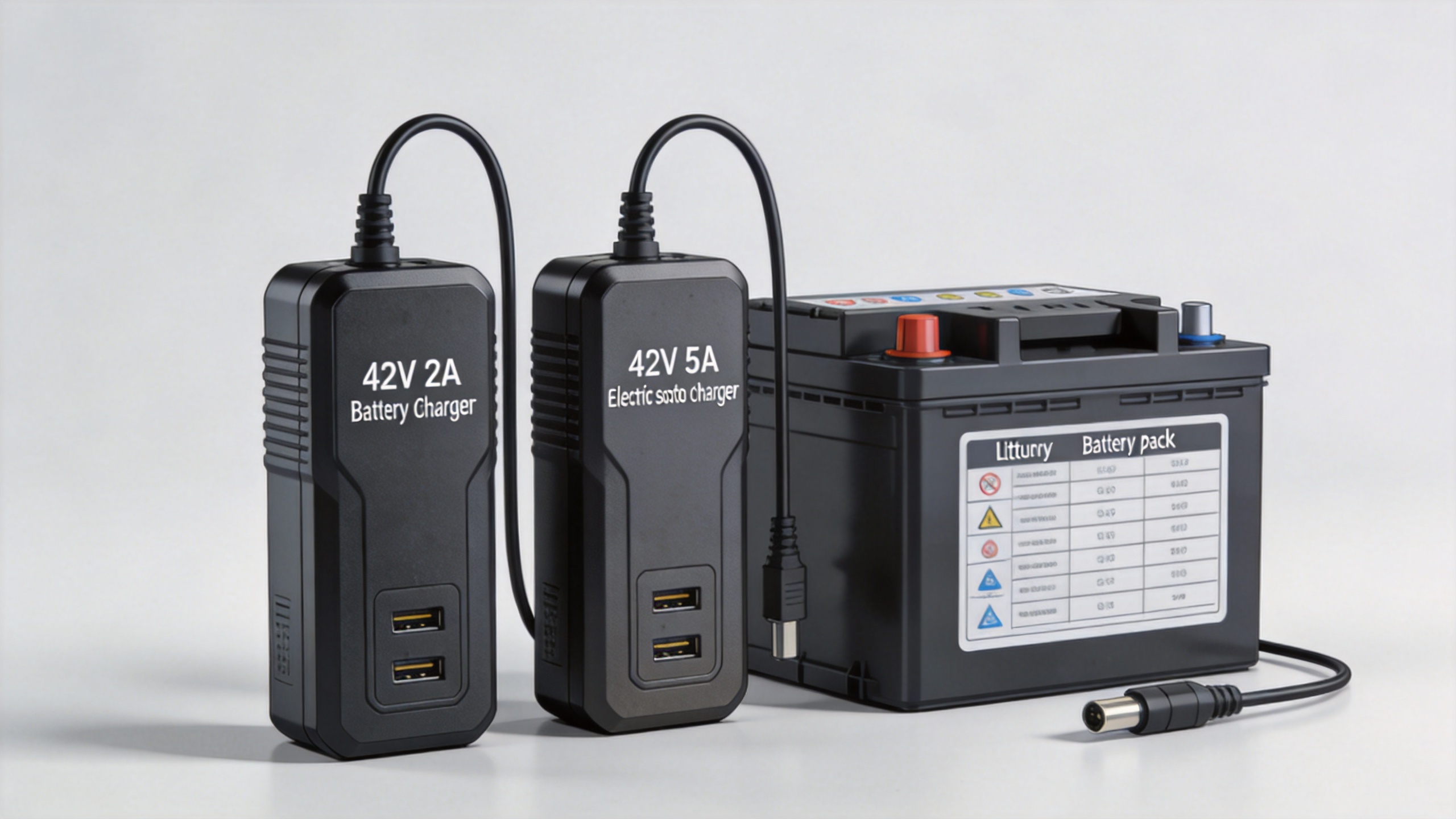
When the original scooter charger was 2A, a like-for-like 42v 2a scooter charger is often easier to qualify because it preserves the original current class. That still does not eliminate the need to check voltage, plug, polarity, and battery documentation. It simply avoids making a current increase at the same time as the replacement decision.
For example, the confirmed product listing for a 42V 2A scooter charger with a DC 5.5 × 2.1 connector shows why connector detail belongs in the purchase specification. A DC 5.5 × 2.1 plug is not a universal scooter standard; a matching diameter does not by itself confirm polarity, pin length, fit depth, or wiring correctness.
What must be checked before approving a 42V 5A charger
A 5A charger should be treated as a system change, not merely a faster version of a 42v 2a battery charger. Ask for written confirmation that the pack can accept 5A. Then validate the current path: BMS, charge port, harness, connector contacts, fuse arrangement, and charger enclosure all need to tolerate the proposed use.
Buyers sometimes compare charger cases and assume the larger label tells the whole story. In practice, output protection, insulation, strain relief, heat dissipation, and production consistency matter just as much. For a 5A proposal, sample-test the actual combination of charger and battery pack. Observe connector temperature, cable temperature, charger temperature, charge completion behavior, and repeatability across more than one sample.
- Obtain the battery manufacturer’s maximum charge-current specification.
- Confirm the BMS charging limit and whether it has a defined over-temperature response.
- Verify connector type, polarity, dimensions, and contact condition against the scooter harness.
- Check charger input plug, voltage range, and destination-market electrical requirements.
- Run a controlled sample test with the intended battery, not a different laboratory pack.
- Approve mass production only after label, cable, connector, and output checks match the approved sample.
Connector, polarity, and communication details can defeat an otherwise correct charger
Compatibility is often lost at the interface rather than at the 42V label. Document the plug outer diameter, inner diameter, pin length, polarity, insertion depth, cable exit direction, and any keyed or multi-pin arrangement. If the scooter uses a proprietary connector or a data-enabled charging port, a generic barrel-plug charger may not be appropriate even when voltage and current appear correct.
It is also worth separating mechanical fit from electrical fit. A plug can enter the port while making poor contact, reversing expected polarity, or bypassing an intended interlock. For a 42v 2a battery charger replacement, include connector photos and a polarity diagram in the RFQ. For a 5A upgrade, make this documentation a mandatory gate before ordering.
Build a purchase specification instead of buying by label
The most reliable approach is to turn compatibility into a controlled specification. Ask suppliers to quote against the same document, then compare their answers rather than comparing marketing titles. This also makes it easier to manage multiple scooter models without mixing chargers in the warehouse.
- Nominal battery system, chemistry, and approved charge voltage
- Maximum permitted battery and BMS charge current
- Required charger output current: 2A, 5A, or another approved value
- Connector drawing, polarity, cable length, and labeling requirements
- Input plug and input-voltage requirements for each sales market
- Protection behavior, indicator behavior, enclosure, and thermal test expectations
- Sample approval criteria, incoming inspection method, and SKU identification
Which charger should a buyer choose?
Choose a 42v 2a battery charger when the original system is designed for 2A, the charging window is acceptable, or documentation for a higher current is unavailable. Consider a 42V 5A charger only when the battery maker and BMS specification explicitly permit it and sample testing validates the complete system. The right choice is therefore conditional: a 5A charger can support faster turnaround, but it is not a universal upgrade.
For B2B sourcing, a practical next step is to request battery specifications, port photos, connector dimensions, and the original charger label before finalizing an RFQ. A supplier with electric scooter parts experience can help organize the comparison, but the approved battery-system specification should remain the final authority. That discipline reduces compatibility claims and makes repeat ordering of a 42v 2a scooter charger or a qualified 5A alternative much easier to control.