EN
EN


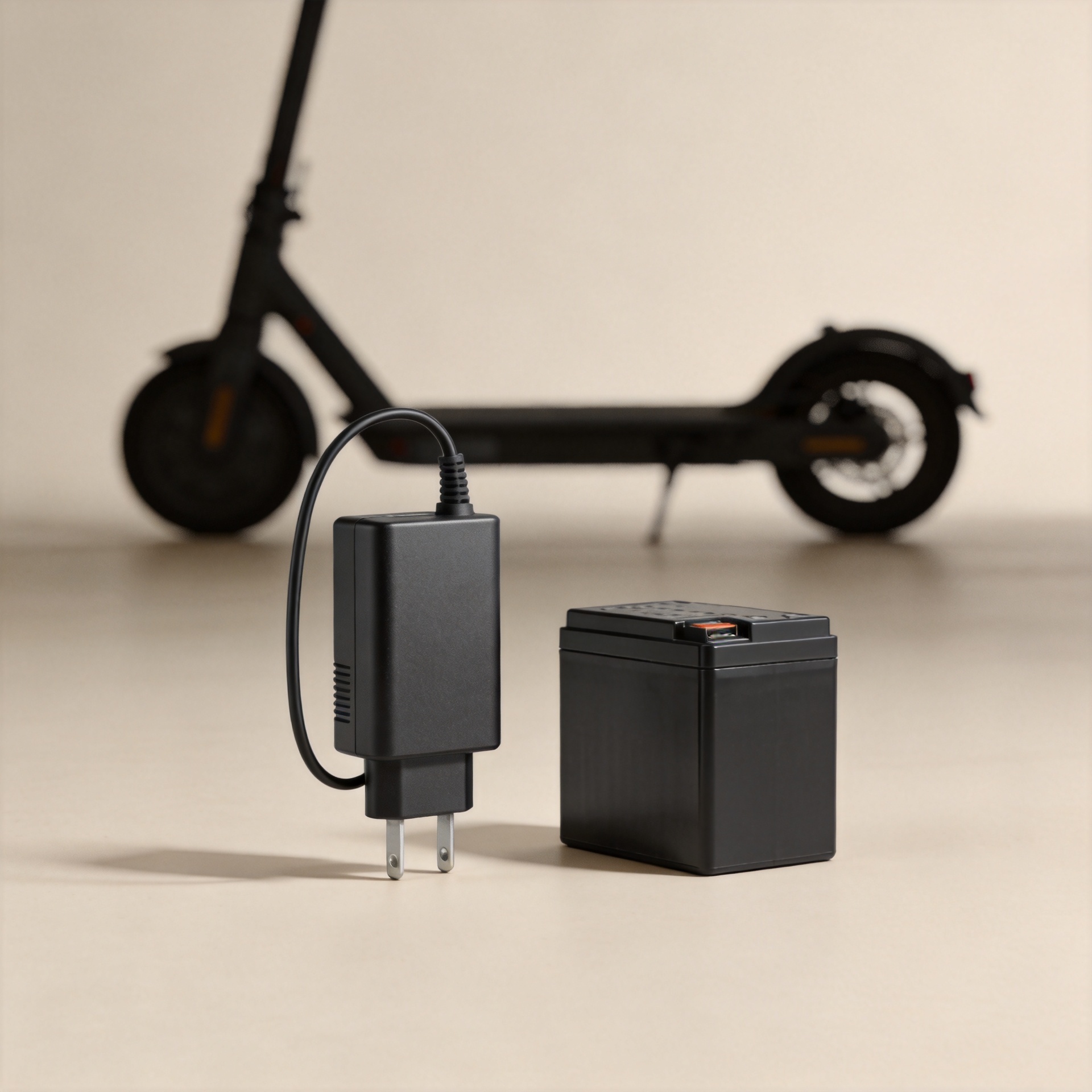
How to Choose a Battery Charger for Lithium Batteries: Voltage, Current, and Plug Compatibility
Choosing a battery charger for lithium batteries is not a matter of finding a plug that fits. For an electric scooter, the charger, battery pack, battery-management system (BMS), and connector must work as one system. A charger with the wrong output can stop charging early, trigger BMS protection, overheat components, or—in the worst case—damage the battery. This guide gives distributors, repair shops, and riders a practical way to check compatibility before ordering.
The safest starting point is the battery label or the original charger label. Compare the printed output rating, chemistry, polarity mark, and connector dimensions. If any of those details are missing, ask the battery or scooter manufacturer before connecting a replacement.
Start with battery chemistry and charge voltage
A battery’s nominal voltage is not necessarily the voltage a charger outputs at the end of charge. That distinction is where many replacement decisions go wrong. For example, a pack described as “36V” is often built from ten conventional lithium-ion cells in series and commonly uses a 42V charger. The 36V figure describes the pack’s nominal operating voltage; 42V is the typical full-charge target for that cell arrangement.
But do not turn that example into a universal rule. A LiFePO4 battery charger follows a different charge-voltage profile from a conventional lithium-ion charger. Battery University notes that many conventional Li-ion chemistries charge to about 4.20V per cell, while LiFePO4 cells typically charge to about 3.65V per cell. Pack design, series-cell count, and the BMS determine the final charger requirement. Therefore, confirm the chemistry and the charger’s output voltage—not only the large nominal voltage printed in a listing.
A voltage check that prevents costly mistakes
- Read the battery-pack label for chemistry, nominal voltage, and any stated charging limit.
- Read the original charger label for DC output voltage and polarity.
- Match the replacement charger’s regulated DC output to the approved charge voltage.
- Do not use an adjustable charger unless its setting, chemistry support, and connector are explicitly verified for that pack.
A higher-voltage charger is not a “faster” alternative. Voltage establishes the charging target; it must be correct before current is even considered.
Choose charging current within the battery’s allowed range
Once voltage and chemistry are confirmed, check the output current in amps. Current affects how quickly the pack charges and how much heat is generated in the charger, cable, connector, and battery. The right current is the value the battery maker or BMS allows—not simply the largest amp rating available.
In practical purchasing, a charger may be capable of supplying more current than a battery should accept. The BMS may limit charging, but relying on that limit is not a selection strategy. Start with the original charger’s current rating, then check the battery documentation for a maximum charge current. If the replacement has the same approved voltage and a lower current rating, charging may simply take longer. A higher current rating should be used only when the pack, BMS, wiring, and connector are confirmed to support it.
For a fleet or repair inventory, ask for a compatibility sheet that records battery voltage, charger output voltage, maximum permitted current, connector type, polarity, and target market plug. That is more reliable than ordering by scooter model name alone.
Verify the connector: size, polarity, and pin arrangement
The plug is the last check, not the first. Two barrel connectors can look nearly identical but differ in outside diameter, center-pin diameter, length, or polarity. A loose plug can create resistance and heat; a mechanically fitting plug with reversed polarity can cause immediate damage.
- Measure the barrel: record outer diameter × inner diameter, rather than describing it as “round.”
- Confirm polarity: compare the center-positive or center-negative symbol on the original charger and the battery port documentation.
- Inspect pin count: some scooter systems use multi-pin or communication-enabled connectors; a simple DC barrel charger is not automatically interchangeable.
- Check cable and strain relief: the connector should seat fully without forcing it, and the cable should not pull sideways when the scooter is parked for charging.
Many buyers discover this only after a return: a replacement can have the same-looking barrel plug but a different center-pin size. Treat the connector drawing or a caliper measurement as a required purchase field.
Match the AC input plug to the destination market
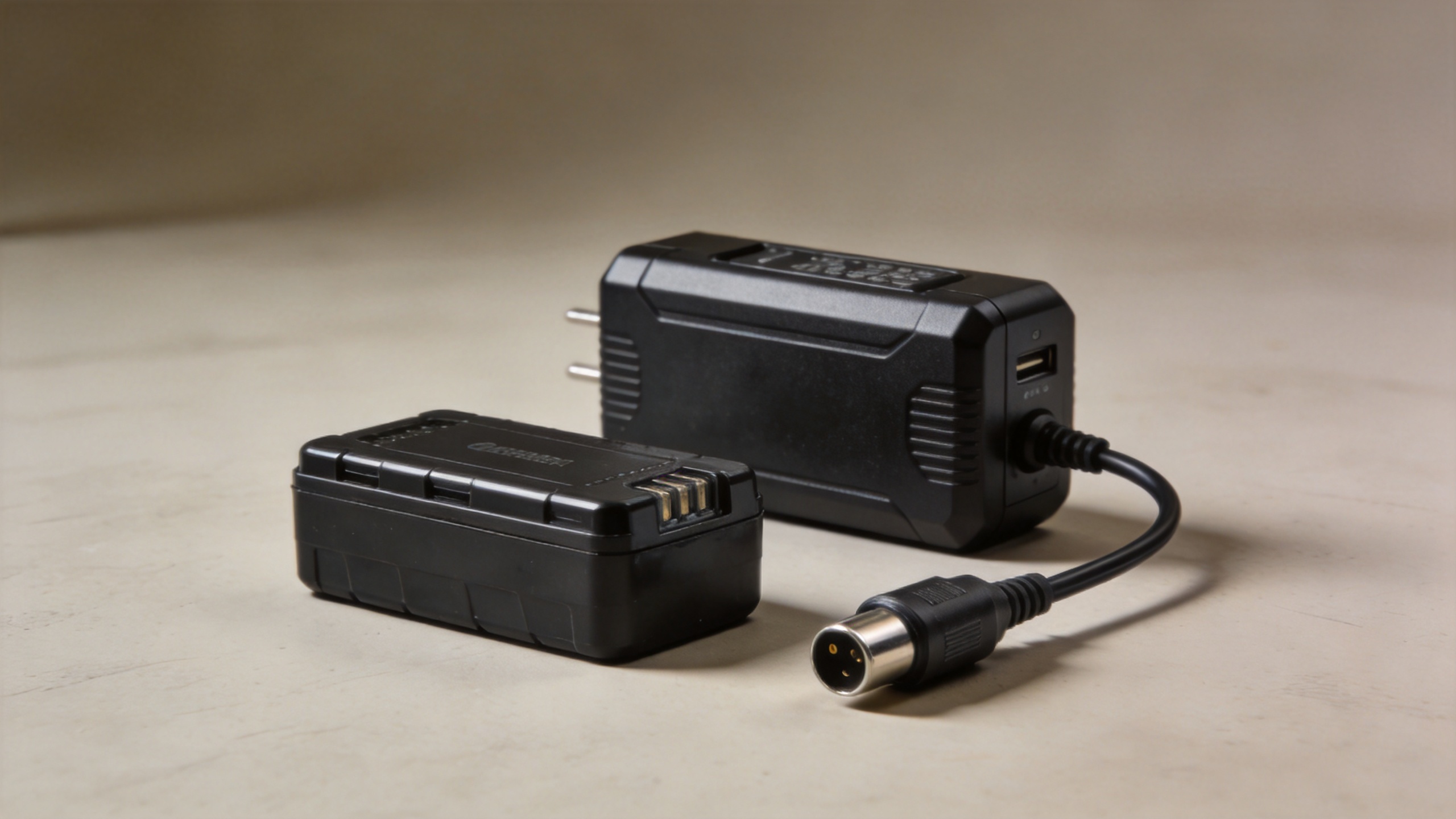
AC input compatibility is separate from the DC output that reaches the battery. A charger may have the right DC specification yet be unsuitable for the wall supply or plug standard. Check the charger’s input range, such as the AC voltage and frequency shown on its label, then select the appropriate mains plug or approved cable for the market. Do not confuse an AC plug adapter with a voltage converter.
This point matters for cross-border scooter-parts purchasing. Before shipment, confirm the DC charging specification, local mains input compatibility, plug format, labeling, and any applicable market compliance requirements with the responsible importer or compliance team.
Use a model-specific charger only after checking the label
A verified product listing can make sourcing easier, but it is still a starting point for confirmation. For example, this 42V 2A DC 5.5×2.1 scooter charger adapter is described for specific scooter models and carries a stated 42V/2A and 5.5×2.1 connector configuration. It may suit a compatible 36V nominal scooter battery system, but only if the battery chemistry, approved 42V charge limit, polarity, and plug dimensions match the actual unit being serviced.
That last condition is important. Model names can vary by production batch and market. The label on the physical battery and original charger remains the final authority.
A final compatibility checklist
Before you buy a battery charger for lithium batteries, verify these five items in order:
- Battery chemistry and approved charge profile.
- Exact DC output voltage, distinct from nominal pack voltage.
- Maximum safe charging current for the battery and BMS.
- Connector dimensions, polarity, pin layout, and cable condition.
- AC input range, wall-plug format, and destination-market requirements.
If one field cannot be confirmed, pause the purchase. A compatible LiFePO4 battery charger or lithium-ion charger is defined by the complete electrical and mechanical match, not by a similar plug or a familiar scooter model name. For buyers building stock, collecting these details before placing a batch order helps reduce returns, charge failures, and avoidable safety complaints.
Common Questions
Can a battery charger for lithium batteries use the same plug as the original?
A battery charger for lithium batteries may fit physically and still be unsuitable. Confirm the output voltage, polarity, and plug dimensions before approval.
Is a 42V battery charger for lithium batteries suitable for every 36V pack?
No. A battery charger for lithium batteries must match the specific chemistry and series-cell configuration documented for that pack.
Does more amperage make a battery charger for lithium batteries better?
No. A battery charger for lithium batteries should remain within the battery maker’s permitted charging-current limit and the BMS limit.
When is a LiFePO4 battery charger required?
Use a LiFePO4 battery charger when the pack is confirmed as LiFePO4 and the pack documentation requires it. A LiFePO4 battery charger is not a substitute for a conventional lithium-ion charger.
Can a LiFePO4 battery charger charge every lithium pack?
No. A LiFePO4 battery charger is chemistry-specific. Check the pack label first.
What should be recorded for a replacement battery charger for lithium batteries?
Record the battery chemistry, nominal pack voltage, approved charge voltage, maximum current, polarity, connector dimensions, and AC input requirements. This supports repeatable procurement.
Why check polarity on a battery charger for lithium batteries?
Polarity is an electrical requirement, not a cosmetic detail. A battery charger for lithium batteries with the wrong polarity should not be connected.
Should a distributor keep a LiFePO4 battery charger separate from other inventory?
Yes. Clear chemistry labeling reduces mix-ups. A LiFePO4 battery charger should be stored and listed with its approved voltage and connector specification.
What if the battery label is unreadable?
Do not guess. Hold the order until the correct specification is confirmed.
Can an AC travel adapter make a battery charger for lithium batteries compatible?
An AC plug adapter only changes physical wall-plug fit. It does not change the approved DC output needed by a battery charger for lithium batteries.
Why does a LiFePO4 battery charger need a separate check?
Its charge profile differs from many conventional lithium-ion packs.
What is the final rule for a battery charger for lithium batteries?
Choose a battery charger for lithium batteries only when every electrical and mechanical field has been confirmed from reliable documentation.