EN


Electric Scooter Charger Wholesale Checklist for Importers
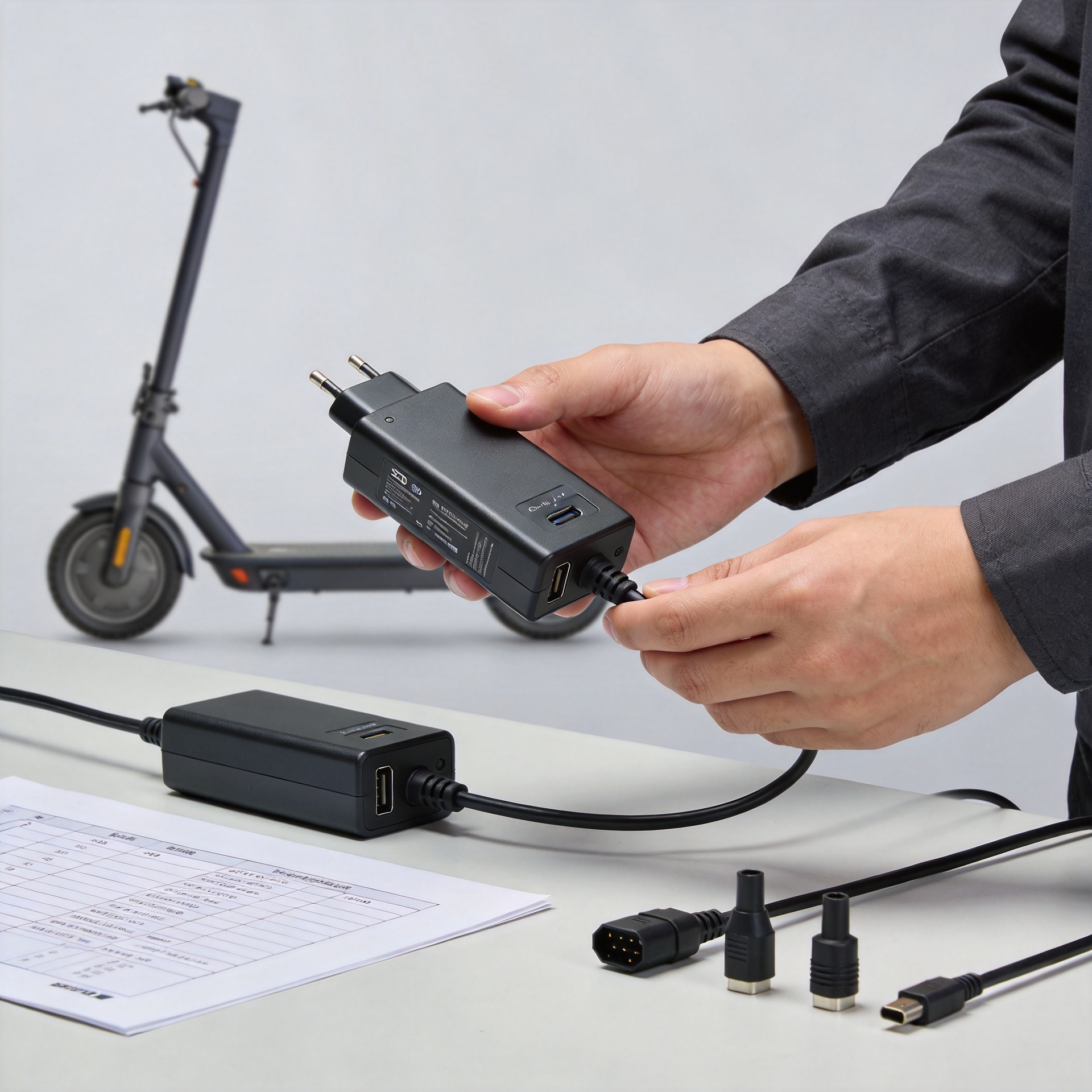
Buying a scooter charger in bulk looks simple until a shipment reaches a warehouse with the wrong plug, the wrong connector, or a label that does not match the battery system. For importers, distributors, and repair-network buyers, a charger is not a generic accessory. It is an electrical match between a battery pack, a vehicle model, a target-market AC supply, and an after-sales process.
As a practical sourcing rule, start with compatibility before price. A low unit price can disappear quickly if a batch needs rework, generates returns, or cannot be assigned to the intended models. This checklist helps buyers prepare a clearer RFQ for a scooter charger, compare samples, and reduce avoidable purchasing errors.
1. Start with the battery system, not the charger label
The first item on every scooter charger purchase sheet should be the battery chemistry and nominal battery voltage. These are not interchangeable with the charger output shown on the label. For example, many 36 V lithium-ion scooter systems use a charger with a 42 V DC output. That does not mean every 42 V product will fit every 36 V scooter; the battery management system, connector, polarity, current rating, and vehicle wiring still need confirmation.
- Battery chemistry: lithium-ion, lead-acid, or another specified system.
- Nominal battery voltage and required charger output voltage.
- Required output current and acceptable charging-time expectation.
- Battery capacity range, where it affects the preferred charging current.
- Charging-port polarity and any model-specific interlock or communication requirement.
Do not ask only for a “universal e scooter charger.” Instead, provide the supplier with a label photo, battery specifications, charging-port photo, vehicle model list, and the intended replacement use. This creates a traceable compatibility discussion rather than a guess based on appearance.
2. Build a connector and plug matrix before placing an order
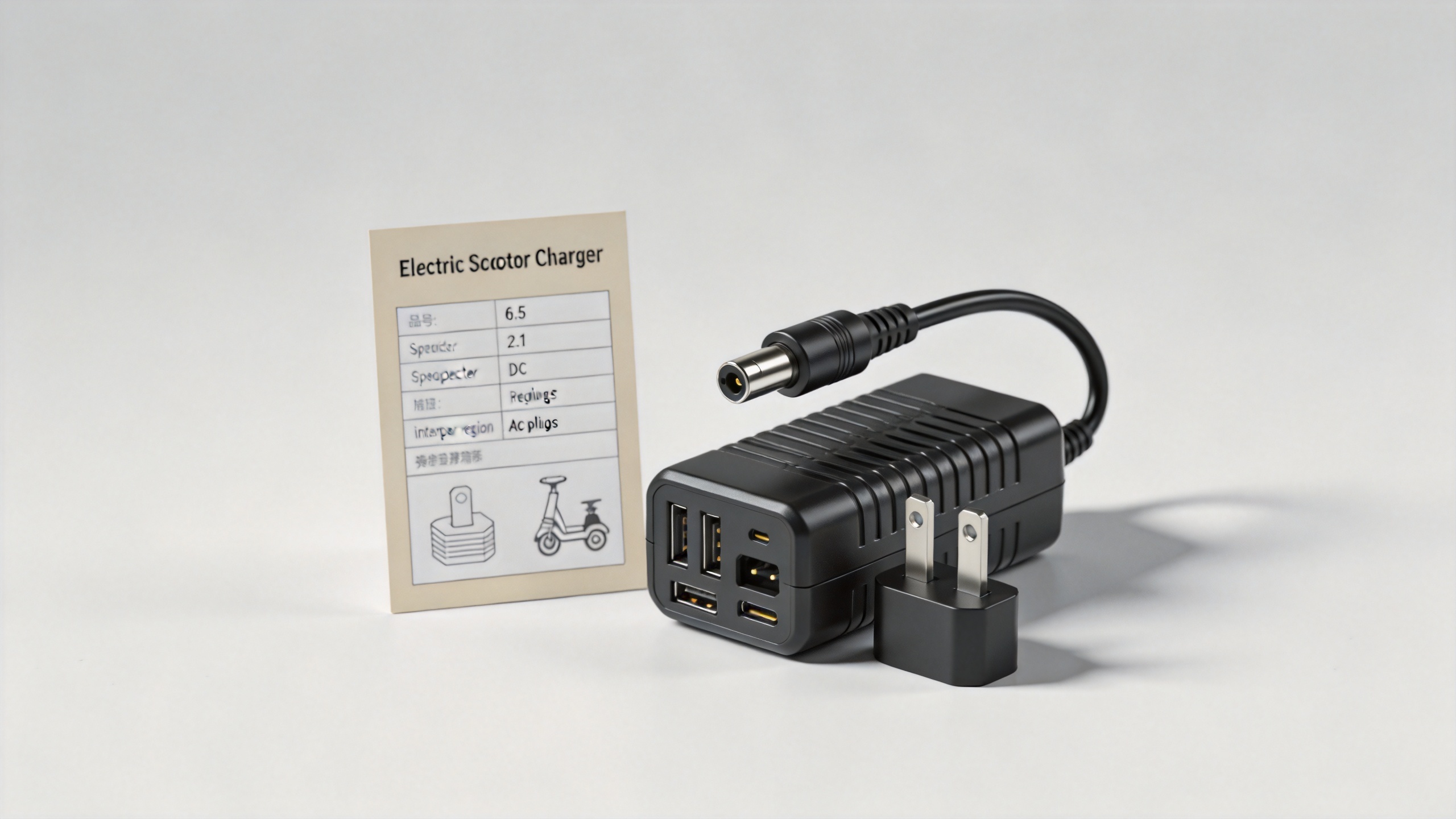
A correct voltage with an incorrect connector is still an unusable scooter charger. Connector dimensions, pin count, pin arrangement, locking method, and polarity must all be confirmed. DC barrel connectors, XLR-style connectors, aviation connectors, and proprietary formats can look similar in a product photo while differing in electrical or mechanical fit.
| RFQ field | What to confirm | Why it matters |
|---|---|---|
| DC output | Voltage, current, rated power, tolerance | Prevents mismatch with the battery system. |
| Connector | Type, dimensions, pins, polarity, photos | Reduces fitment and wiring errors. |
| AC input | Input-voltage range and frequency | Confirms suitability for destination-market mains power. |
| Mains plug | EU, UK, US, AU, or customer-specified plug | Prevents local resale or packing changes after arrival. |
| Lead and housing | Cable length, strain relief, enclosure and label language | Supports shelf presentation and service handling. |
For a decision-stage order, request a connector drawing or clear multi-angle photos alongside the sample. A “fits Model X” claim should be backed by the exact version of Model X, because production revisions can change the charging port even within one scooter family.
3. Treat output current as a stocking decision
Output current affects charging speed, heat, price, and positioning in your catalog. A 2 A scooter charger may suit a common replacement program, while a higher-current unit may require a separate compatibility review. A dependable wholesale assortment is not necessarily the fastest charger; it is the group of specifications your customers can identify and use correctly.
Many buyers initially focus on the lowest charger price. In practice, the hidden cost is often return handling caused by unclear fitment instructions or mixed connectors in one shipment. Build a stock plan around a small number of well-documented voltage and connector combinations first. Add variants only after you can label, pack, and support them reliably.
4. Request safety and compliance evidence for the destination market
Compliance requirements vary by market and by the way the product is sold. Importers should ask suppliers what evidence is available for the specific scooter charger model, then have their own compliance team verify what is required for the destination country. Do not treat a logo in a listing image as sufficient documentation.
- Product specification sheet and rating-label artwork.
- Test reports or declarations relevant to the target market, where available.
- Traceability information: model number, batch or production reference, and supplier contact details.
- Packaging and instruction language needed for your sales channel.
- Battery-system safety documentation where the order is supplied with batteries or complete vehicles.
For context, battery-safety discussions often refer to standards such as IEC 62133, while charger-safety evaluation may involve standards such as IEC 60335-2-29 depending on the product and market. These references are not a substitute for local compliance advice. Use them to frame the documents you need to request and review.
5. Validate samples with a repeatable test record
Before approving a wholesale scooter charger order, test samples against the actual target scooters or a controlled battery setup. Record the model, battery specification, connector orientation, charge-indicator behavior, charging start/stop behavior, and any unexpected heat or noise. A simple sample log makes it easier to compare supplier revisions and train your receiving team.
- Photograph the input label, output label, plug, connector, and cable entry point.
- Confirm output and connector details against the approved RFQ.
- Test on the named target model under a supervised procedure.
- Check packaging, barcode needs, plug allocation, and instruction inserts.
- Approve a retained reference sample before mass production.
For buyers sourcing 42 V, 2 A units with a 5.5 × 2.1 mm connector for specific models, review the available 42 V 2 A DC 5.5 × 2.1 scooter charger option as a starting point for the RFQ—not as a substitute for confirming each target vehicle.
6. Ask suppliers the questions that prevent replenishment problems
Reliable replenishment is part of charger sourcing. A supplier that can help verify compatibility, prepare market-specific plugs, and keep model information organized can be more useful than one that offers only a lower quote. This matters especially when you stock for Europe, North America, Oceania, or South America, where plug formats and documentation expectations may differ.
- Can the supplier confirm the exact target model and charging-port version in writing?
- Which plug options can be packed separately, and how will cartons be marked?
- Can labels, manuals, or private-label packaging be prepared for your order?
- What is the process for approving a production sample and retaining a reference unit?
- How will the supplier handle specification changes on later purchase orders?
Technical pre-sale support is valuable here: it helps a buyer translate a customer’s scooter information into a defined charger specification before the purchase order is released.
Final pre-order checklist
Before issuing a PO for a scooter charger, make sure every SKU has a confirmed battery system, charger output, connector specification, polarity record, AC-input requirement, destination plug, label language, sample result, and documentation request. Keep the approved sample and its RFQ together. That one discipline helps importers turn a generic accessory category into a manageable, repeatable wholesale line.
For an e scooter charger range, the safest procurement decision is usually a well-documented compatible option—not the option that merely looks the same in a catalog photo.