EN


Sine Wave vs Square Wave E-Bike Controllers: What Buyers Need to Compare
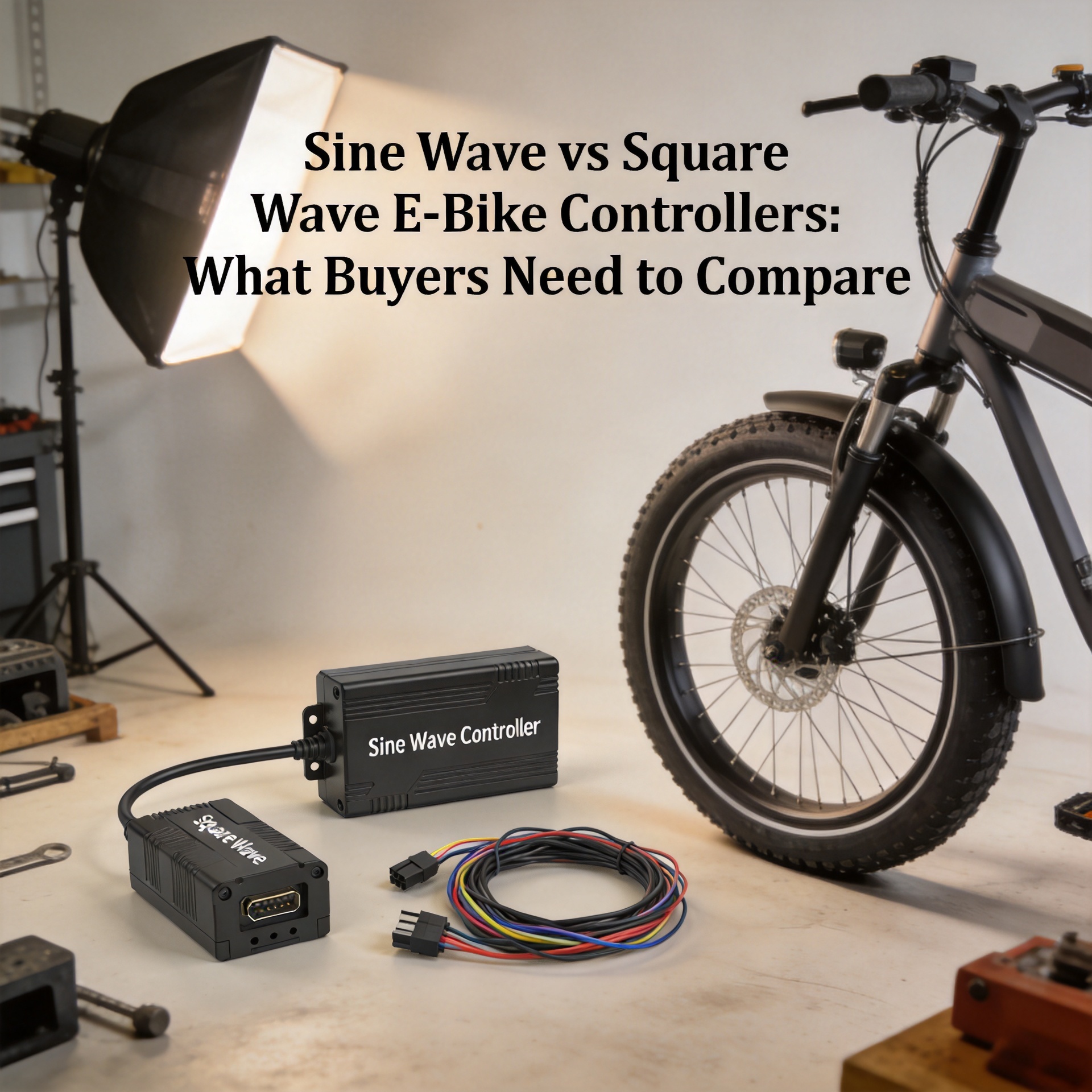
When a buyer compares a sine wave vs square wave controller, the practical question is rarely which label sounds more advanced. The better question is whether the controller matches the battery, motor, wiring harness, display, and intended riding use of the vehicle it will serve. For replacement and wholesale purchasing, waveform is one decision point inside a much larger compatibility check.
A controller manages how power from the battery is delivered to a brushless motor. Its switching pattern affects how the motor is driven, which can influence sound, smoothness at low speed, heat behavior, and the feel of acceleration. Those effects matter, but they do not override the fundamentals: voltage class, current limit, sensor arrangement, connector pinout, and physical installation space must still match.
Start with the buyer’s objective, not the waveform label
For a sine wave vs square wave controller decision, first define the job. Is the buyer replacing a failed unit on an existing e-bike, building a compatible service inventory, or specifying a controller for a new vehicle program? A replacement purchase calls for close system matching; a new build can weigh ride refinement, budget, and control-system architecture more freely.
Waveform does not make a controller universal. A well-regarded controller can still be the wrong replacement if the motor’s hall-sensor wiring, phase-wire order, communication signals, or display protocol do not align. In cross-brand sourcing, that risk is often more important than the difference between sine and square commutation.
How sine-wave and square-wave control differ
In a sine wave vs square wave controller comparison, this distinction describes the way the controller commutates the motor; it does not, by itself, confirm that a replacement is electrically compatible.
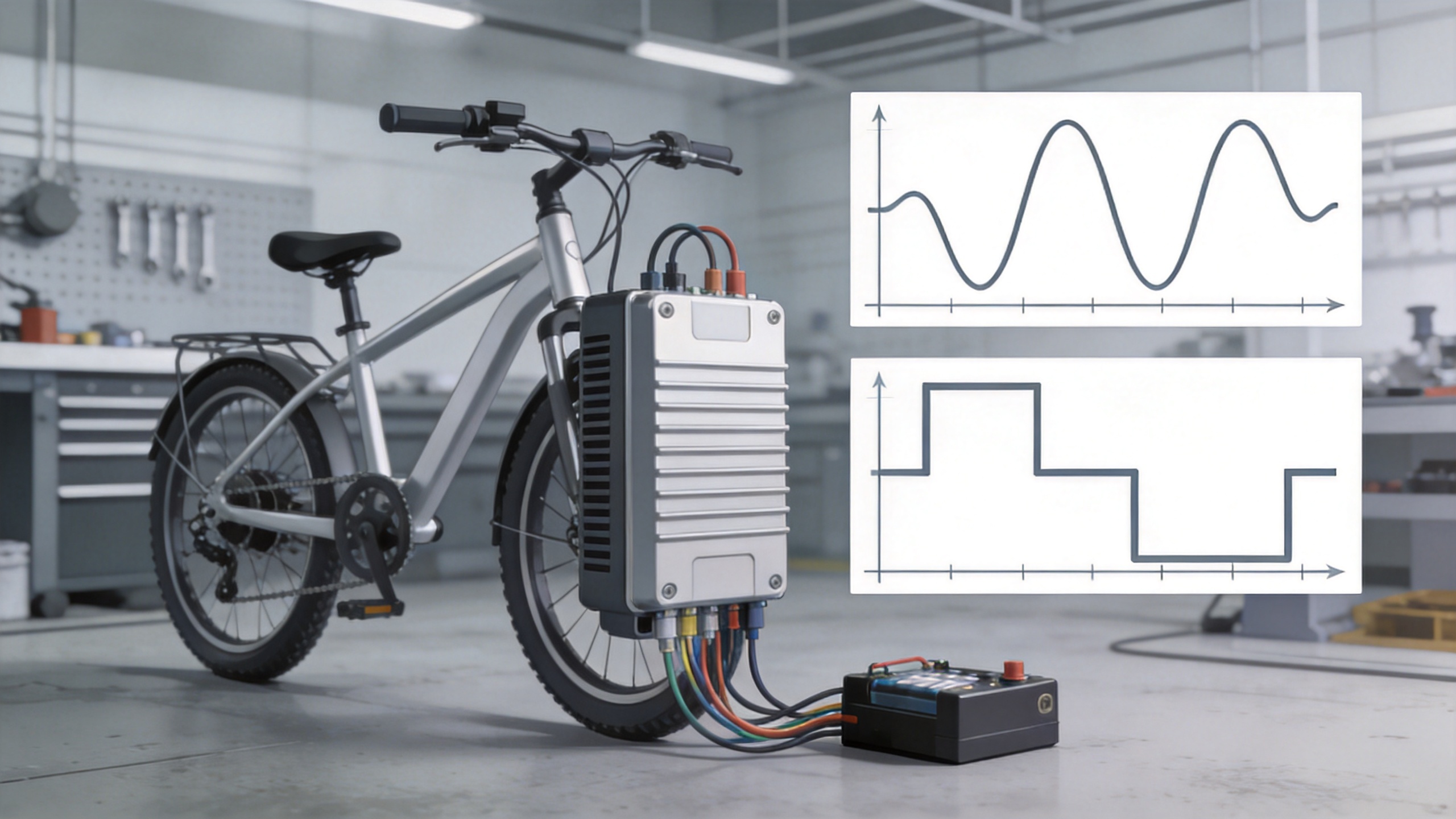
A square-wave controller drives motor phases with more abrupt switching. A sine-wave controller aims to shape phase current more smoothly. In real vehicles, the experience depends on the motor, firmware tuning, current settings, load, and the rest of the electrical system, so buyers should treat broad descriptions as tendencies rather than guarantees.
| Comparison point | Sine-wave controller | Square-wave controller | Buyer takeaway |
|---|---|---|---|
| Current delivery | Smoother-shaped commutation | More abrupt commutation pattern | The electrical approach is different; it is not a simple quality ranking. |
| Low-speed feel | Often selected when smoother starts and transitions are a priority | May feel more direct depending on tuning and motor pairing | Ask for the intended riding feel and test on the target motor when possible. |
| Audible motor sound | Commonly associated with lower audible motor noise | May produce more noticeable motor sound | Noise sensitivity matters for commuter-oriented and premium-positioned models. |
| Cost and system fit | Can require a more specific system match | Often used in cost-conscious designs | Compare the full replacement and support cost, not only controller price. |
It is tempting to assume that sine wave necessarily means better. That is too broad. If a fleet needs a verified, cost-conscious replacement for an existing square-wave system, changing waveform without validating every interface can create more service work than it saves. Conversely, a vehicle program aimed at a quieter, more refined ride may reasonably make smoother control a higher priority.
The compatibility checks that decide whether a replacement will work
For every sine wave vs square wave controller purchase, use this checklist before treating waveform as the deciding factor. A controller with the preferred waveform is still unsuitable if its motor, wiring, or battery interface differs from the target e-bike.
The most useful sine wave vs square wave controller comparison becomes a checklist. Before ordering samples or a production batch, verify these items against the original controller label, vehicle documentation, and actual harness:
- Battery voltage class: Confirm the controller is designed for the vehicle’s battery system. A connector fit does not prove voltage compatibility.
- Current limit: Check the controller’s continuous and peak-current behavior against the battery, BMS, wiring, and motor limits. More current is not automatically an upgrade.
- Motor configuration: Identify sensorless or hall-sensor operation, phase wires, and hall-wire layout. Do not assume colors or plug shapes are standardized across brands.
- Throttle, brake, PAS, and display signals: Confirm connector pinout, signal type, and any protocol requirements before installation.
- Physical fit and thermal path: Measure mounting points, enclosure dimensions, cable exit direction, and available airflow or frame contact.
- Firmware and feature behavior: Verify speed limits, start mode, regenerative functions where applicable, and error-code behavior with the intended display.
For replacement inventory, capture photos of labels and connectors as part of the purchasing record. When troubleshooting, an ebike fuse replacement should be paired with a check for the underlying short, overload, or wiring fault; otherwise the new fuse may fail again. An ebike fuse replacement is a protection-maintenance action, not evidence that the controller is correct. This is a simple control that can prevent an ebike fuse replacement, controller-return, or installation issue from being misdiagnosed as a product defect. A blown fuse can be a symptom of a wiring, current, or component problem; replacing it without tracing the cause is not a controller compatibility test.
Use a model-specific controller only after confirming the model details
A sine wave vs square wave controller assessment becomes more reliable when the original unit is documented first. Model-specific references can narrow the search, but they do not replace a connector and signal check.
When the target vehicle and original specification are known, a model-specific option can make the sourcing conversation clearer. For example, the confirmed product record for the Engwe EP-2 Pro 48V 18A Controller — E Bike Controller Replacement Wholesale EN-EP2P23 identifies its intended model and 48V/18A designation. That makes it a relevant starting point for an EP-2 Pro replacement discussion, not proof that it fits every 48V e-bike.
Before placing an order, compare the original label, harness photographs, plug count, pin positions, and controller enclosure dimensions. If the vehicle uses a proprietary display or communication line, request confirmation for that interface as well. The disciplined approach is to validate the exact application rather than infer compatibility from nominal voltage and current alone.
Choose by application: when each approach can make sense
Use the sine wave vs square wave controller distinction to prioritize the experience the vehicle needs after the baseline compatibility checks have passed. That order keeps a waveform preference from becoming an avoidable installation problem.
Prioritize smoothness and lower perceived noise
A sine-wave option may be worth prioritizing for city commuters, premium retail positioning, or applications where low-speed refinement matters. But the buyer should still ask how the controller was matched to the motor and what inputs it expects from the display and sensors.
Prioritize a known replacement architecture
For service departments and distributors, retaining the original architecture can reduce uncertainty. If the installed system is square-wave and works well with the vehicle’s motor and controls, an accurately matched square-wave replacement may be the lower-risk choice. The goal is reliable integration, not a label change for its own sake.
Prioritize repeatable wholesale purchasing
For repeat orders, build a controller comparison sheet that records vehicle model, battery voltage, current rating, motor type, connector map, display version, enclosure dimensions, and test result. This turns a one-off compatibility check into a reusable procurement standard and helps prevent mixed stock from reaching installers.
A practical purchase sequence for buyers
This sequence translates a sine wave vs square wave controller comparison into a repeatable purchasing process for distributors, repair shops, and vehicle-program buyers.
- Identify the exact e-bike model, year or version, and the reason for replacement.
- Document the original controller label and every connector with clear photos.
- Compare voltage, current limits, motor-sensor setup, signal connectors, and physical dimensions.
- Decide whether smoother control or continuity with the original system matters more for the application.
- Test a sample on the target vehicle before committing to wider distribution or inventory.
- Record the validated pairing, including any installation notes and fuse-protection observations.
Final perspective: compatibility makes the comparison useful
In short, the sine wave vs square wave controller question is useful only after the vehicle system has been mapped. It is a selection factor, not a substitute for fit verification.
The right sine wave vs square wave controller choice depends on the vehicle system and the buyer’s priorities. Sine-wave control may support a smoother and quieter experience; square-wave control may be appropriate where a proven original architecture, straightforward service replacement, or cost discipline is the main concern. Neither choice should bypass compatibility verification.
For buyers serving multiple e-bike models, the strongest long-term practice is to treat controllers as system-specific parts. Confirm the electrical and mechanical interfaces first, then use waveform, ride feel, stock strategy, and support needs to choose between viable options.